Pages

Showing posts with label Pre Production. Show all posts

Wednesday, 10 April 2013

Cue Sheets

Cue Sheet 1

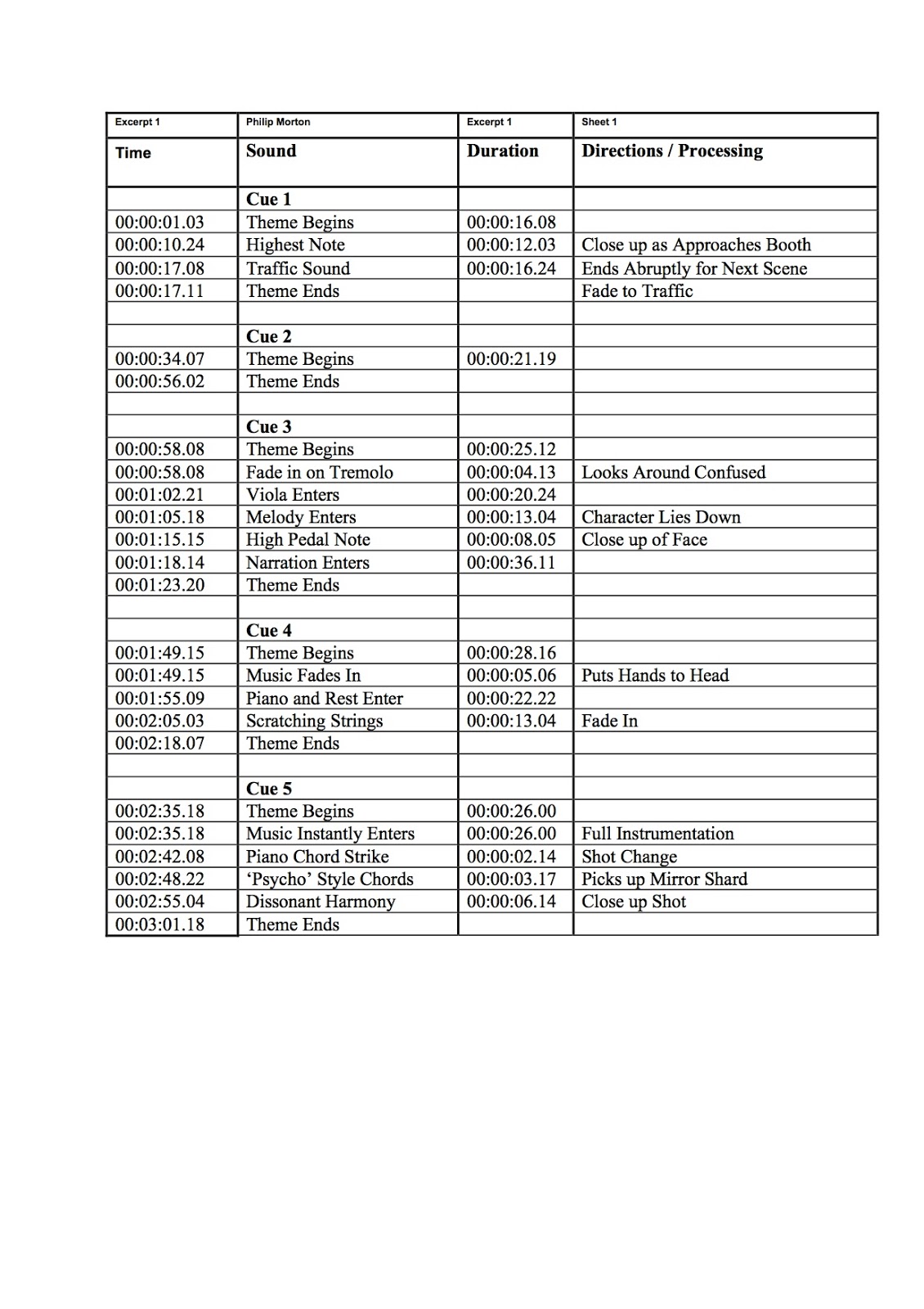
For each of my film excerpts, I prepared cue sheets to establish the main hitpoints in which music enters or causes a desired effect. Cue sheets are used to directly identify time down to the exact frame per second that a sound is to be heard, they identify what sound it is that is to be produced, how long that sound is to last for and any extra comments or directions. Writing up a cue sheet for me was ideal for knowing where each musical theme was to enter and finish and where I thought certain changes in camera shot or scene change could benefit from becoming musical hitpoints for a change in music, melody or adding chords or harmony such as toward the end of Excerpt One where chords played on piano occur directly on the camera shot change to add to the shock/chaotic factor of the piece and to develop the suspense within the music. 
Cue Sheet 2

Sunday, 7 April 2013

Mildred Pierce (1945, Dir. Michael Curtiz, Comp. Max Steiner)

The following is an example of a manipulated theme that i have initially written as a paragraph for my dissertation. I feel this to be of relevance to my project as it details not just a change in theme to change mood or emotion but to change the state of mind from the characters perspective and for us to understand the characters mental state at that time.


Mildred Pierce (1945) tells the story of a long suffering mother and the relationship she shares with her ungrateful daughter. The film is an example of how musical themes may manipulate and vary over the course of a film. When Mildred is stunned by a cruel argument with her daughter, the reaction shot of her is accompanied by a loud and tragic rendition of the first three notes of her theme, becoming a statement not just for the condition of the character ‘Mildred’ but also the condition of a woman as a mother. Upon the ending of the film, as Mildred is reunited with her husband and seen walking away from the police station into the sunrise, the theme is fully reinstated as a complete comparison to its original entrance in the major key by a full orchestra dominated by the brass section. This recollection of the theme is not just used to represent Mildred’s joy and emotional overwhelm but also to act as her resolved state of mind, where in her eyes, all ambiguity has been resolved allowing the light of a new day to shine through. 


Tuesday, 15 January 2013

Executive Summary - From Then Till Now - January '13

I have come a long way in my project since the start of semester one. I've managed to gain a firm understanding of the route I wish to take as to what it is I want to research, what is valuable information to research and how I propose to carry out the practical side to my research.

My blog began with the ideas that I had for my project, what my initial concept was and how I wished to establish that concept. This moved from the study of motif in film to the more developed idea of studying an individual character theme within a film and then a theme that may be manipulated over time as the character changes. I established early on one of the most famous musical motifs of all time, the Jaws theme and how one knows the looming the danger of a presence before seeing one.

The next stage of my blog relates to my research proposal and more importantly the literature review. Around this time I was reading books, journals and articles and constantly keeping notes on related subjects as well as quotes and paraphrases in my notebook. Along with this I kept a log of important readings and how they may relate to my topic on this blog. This included a look at how music is used in film, psychological and emotive responses to music on a listener, the history of musical theme in opera, the limitations of film scoring, 'the eight functions of film music', the relation between music and film and a couple examples of experimentation in fields similar to my study such as the change of perception through music in a health and safety video and how children react to certain types of music.
Also linked to my research proposal is a run down of my aims and objectives as well as the methodology that I am going to use for my project.

The latter part of my blog focuses on pre production, my concept and development.

This began with establishing how it is that I am going to compose, what are the specific hardware and software that I am going to use as well as my initial ideas for chapters that may be included in my final dissertation.
As I began doing practical pre production work, I kept a log of each piece I worked on. This included a various theme variations and one example of 3 varying themes put to a short video clip that I uploaded to this blog. Each theme includes screenshots of the composition during the writing stages and the initial melody that I wrote to be manipulated.

Now I wish to further experiment with compositional ideas that directly relate to what it is that I'm proposing. I need to know the video source that I will be using for my final project and begin to develop a cue sheet for where I want themes to enter and disappear and begin to work on varying musical styles that may apply to the film clip.

I have also included a full bibliography and plan for semester 2.


Saturday, 12 January 2013

Composing To Film

Today I composed a theme and two variations to a piece of film, a clip involving the character 'Jimmy' from the HBO show 'Boardwalk Empire'.

The reason for choosing this as the first season of Boardwalk Empire constantly lead me down different paths of perception, at the start of the season Jimmy to me was not a main character and not one I could identify with but by the end of the first season and into the second he was the character I most wanted to see succeed. The clip itself begins with Jimmy leaving a house for his trip to New York where he faces two men wanting to essentially mug Jimmy of something they believe to be theirs before Jimmy retaliates by murdering the two men before they can get to him.

Before starting to compose music for the clip I studied the film and made a cue sheet of how and where I wanted sounds to enter and exit that were out of the normal flow of music.


For this clip I began writing using piano in the key of G major. As we first see the character I wanted the audience to not see him as a threat, a character that can't be fully read but is not someone who is threatening us. The melodic theme is slow and involves a short descending line within the major scale. Strings are used as to not allow the character to seem all alone and in complete sadness and the harp is used in small, three note ascending patterns to uplift the character.

Jimmys Theme

As Jimmy encounters the men that face him the melody turns to the relative minor key of E minor. The change here is to signify the threat held against our character, he now is in a state unknown. The theme lacks the same power as the introductory theme as our character is to seem more vulnerable in the uncertainty of how he will react. Stabbing chords are played on the piano here with a low and high G at either end and are synced to specific actions we see on screen such as the introduction of the other mens gun. This is to reinforce the shocked feeling that our character me have and the danger that is infront of him. I decided that the music should fade out just before Jimmy kills the two men as to add to the shock of this character defending himself in such a way. The silence adds intensity as we see a new, truer side to the character one that knows the feeling of insanity. 


The third variation of the theme comes after our character has killed the other two men and seems to have no remorse for what he has done. Although the Stabbing G chord comes back and reminds us of the initial key, the melody is instead played starting with A and utilises the accidental of Bflat which was not found in the previous key signature. The reason for this being that we are seeing who the character really is. He is the same man as before but he is not the man we thought he was. 

The following is the resulting video:


Monday, 7 January 2013

Initial Semester 2 Plan


January


  • Create Multiple Small Compositions as Mini Themes
  • Practice Putting Music to Film
  • Further Contact Film Makers
  • Secure Film That Will Use
  • Begin Thinking of How to Conduct Experiment
  • Health and Safety/Ethics Forms Completed
  • Pre Production Portfolio/Concept Development Hand in
  • Begin to Think of Dissertation Chapters


February


  • Cut Film to Size for Project and Select Cue Points
  • Make Cue Sheets for Where Themes Will Lie in Film and How They Will Manipulate
  • Work on Final Composed Themes
  • Begin Work On Dissertation Chapters
  • Look Up Further Research Methods Related to Experiment
  • Map How I Propose to Conduct Experiment
  • Map Out What it is I Want to Find From My Experiment to Create Relevant Questions


March


  • Further Work On Dissertation Chapters
  • Seek Volunteers For Experiment
  • Have Volunteers Accept Terms and Project Outline
  • Finish Compositions and Implement to Film
  • Hold Experiment


April


  • Tie Up Loose Ends With Experimenting
  • Gather All Statistical Data
  • Construct An Analysis of Data
  • Further Work On Dissertation 


May


  • Finish Dissertation
  • Exposition 

Composing A Theme

Today I composed a short theme made up of a four bar melody.

The piece was composed using logic initially with a single piano track for a melody in C major. I had a rough idea of how I wanted the piece to sound, an isolated innocence that didn't become intrusive but instead whispered an unknown sadness. The piece was written at a slow tempo of 98bpm again as to not seem intrusive or to cause a sense of excitement.

Melody 1

The melody worked with interval jumps within the C major scale. First of all a jump of a major third then in the second bar by a major sixth before the route note dropped by a major second, a major third down from C. 

After I had the initially melody written I began writing rough notes on how I wanted the piece to evolve and jotted down what I was doing as I composed so I could further understand what it was that I was doing.


Written notes early in the process - Keys were changed for final mix


I decided that the second variation of the theme should add a sense of intense, pressure, anxiety and switch from being an isolated unknown character to a mysterious dark streaked character. I started this by incorporating the previous melody into a pizzicato and legato cello section. Instead of leaving this in C major I changed to the relative minor of Am. I then added a new melody based on the previous one using C major again but with accidentals that can be found in C minor along with the C major B natural. The reason for this was to add mystery and intrique as well as to take the home key that could be associated with good and altering it to sound further away from the good natured sound. The decision to strip away the piano was down to wanting the new variation to cut out the feeling of vulnerability and instead added low brass and strings to create the darker feel. The tempo was raised to 130bpm in this section to increase the urgent feel of the piece. 


Melody 2


The final variation was again to turn around the feeling we have for the potential character of the piece. Now the character has been dark, they have pulled through the darkness and deceit to become a new person, one that again feels calm and remorse but is still themselves. For this I used the piano once again but kept the melody playing a major third up from C in E, using both ideas from the first melody and the second to propose the idea that this character has built upon everything they have been before to become a new person. I added strings in this section mimicking melody one in the initial C major to harmonise with the new melody predominantly playing above it. To reinforce the feeling that this new character is a combination of the two pervious themes, the tempo was again reduced to 115bpm, sitting in between the two previous themes.  


Melody 3


Final Logic Session


This theme will be available within my pre-production portfolio

Wednesday, 26 December 2012

My Experiment - The Flaws

So now the Lit review/Project proposal has been handed I have gone back to look at my experiment  how it is made up and would like to jot down the main highlighted areas that could go wrong with the experiment and general safety procedures that I wish to carry out to cover myself and others.

First and foremost the film I intend to use is to be an indie film, this is so that no person in the audience can have a preconceived idea as to how to feel towards the main character. It also means I may have full permission from the film maker to use their film in an academic environment. Although I am in talks with a couple film makers to use their films, this does not ensure that they fit the criteria that my music needs. Plan B, if I cannot use an independent film will be to use a lesser known film that has been released. Obviously this means that there is a chance that the audience may have already seen the clips used which is not ideal for the test and also means that I may not have full permission to use the film and will have to be used under strict educational use.

I have written that I wish to use 32 people as subjects as to have a wide pool of results. This may be slightly over ambitious. As a fall back, 24 subjects would be a more manageable number of subjects to use and can easily be broken down into three groups of eight.

All people involved in the subject will be sent a form to tell them exactly what the experiment entails, an example of how the questions will be laid out, will state their anonymity throughout the experiment, state the surroundings that the experiment will take place within along with all times for their attendance. The subjects will be ask to respond to this as an acceptance. The subjects will all be volunteers whether they be peers, students, academics or other. Some backup volunteers should also be required incase any subjects do not attend on the day.

The experiment should take place in a controlled environment, the speakers should not be excessively loud and all in attendance should be comfortable and safe throughout the experiment.

This controlled environment is intended to be a projected screen where the audience can all participate at once. If these plans fall through an online version of the experiment will be available with further instructions as to how to view the video and how to use the questionnaires provided.

Before the experiment begins the subjects will be given the questionnaires for throughout the film and given a briefing as to how to fill them out and what each section means. The subjects will be given a brief explanation as to what the film is but should not  be told that it is about a change in perception as this may sway peoples answers.

THE MAIN PROBLEM 

Now the main problem I have found in my lit review was my quantitative research method. I am right in using a quantitative method of questionnaire that can lead to a statistical analysis of the data received but how I stated to use that data is not the most effective way of gaining accurate results.

The problem lies where I stated that i'd use the mean or average results of data to produce charting evidence of my results. The mean doesn't show a spread of results for example if four people used the rating charts and all though the feeling rated a 1 then the next four people perceived a rating of 7 the average would be 4 which doesn't accurately show the spread of results generated by the audience.

Instead the most accurate way of analysing this data would be through the median, using standard deviation to work out the spread of results and using the interquartile range to further break down the distribution of range.

These methods will be able to show the spread of the audiences results as opposed to one crude average that may not show exactly how the audience responded to the film.
Friday, 21 December 2012

Quick Theme Manipulation

Today I composed a very short theme idea using just piano and cello in C minor. I took the picture bellow of Jack Huston (playing Richard Harrow from Boardwalk Empire) and shaped an identity for him. The idea was that the character initially was unknown, coming out from the shadow into the light with his scarred face that is covered by a plastic mask. The audience can't really tell if this character is good or bad but because of the C minor, high pitched melody with sustained strings lying underneath we are lead to believe that the character is not to be trusted, an enemy or someone with an alterier motive. As this was a quick compositional experiment of changing a melody, I only made the one manipulation of the theme. In the manipulation I changed the key to C major to add a lift to the familier notes from before. The story Idea that I had mapped out was that this character may have initially been a bad person but it's probably that this is because of personal tragedy and loss that they have felt in the past and that there is hope for this character and by doing good and becoming one with other good natured people of this story world, the character is turned around.


Imaged Sourced From:
http://www.tvgasm.com/home/boardwalk-empire-recap-dont-get-too-attached.html

Thursday, 13 December 2012

Dissertation Chapter Ideas

I just thought I'd jot down my initial ideas for possible chapters within my dissertation:

The History of Film Music
What is Compositional Technique?
The Eight Functions of Film Music
Psychological and Emotive Response to Music in Film
Establishing the Theme
Changing the Perception
Previous Experimentation in the Field
My Experiment
Results

This will need to be worked on and refined as I begin semester 2 and work on both my practical project and experimentation

Thursday, 6 December 2012

Relation of Music and Picture

German researcher Pauli (1976) proposed three basic categories of relation between film music and motion pictures.

1) Paraphrasing: The specific character of the music corresponds with the specific content of the picture, the effects are presumably additive.

2) Polarisation: The specific character of the music moves the ambiguous or indefinite content of the picture toward the the character of the music.

3) Counterpoint: The specific character of the music conveys irony or comments on the content of the picture in another way.

For an experiment where I am trying to shift the perception of a character through the use of music, Polarisation seems to fit best in how to attract a development through picture. I don't want for the music to speak alongside the image but for the music to speak for the image.

Thursday, 29 November 2012

Indiana Themes

Indiana Jones - Raiders or the Lost Ark shows extensive use of musical themes and motifs scored by John Williams, none more famous than "The Raiders Theme" otherwise known as "Indy's Theme". The theme is used at several points during the course of Raiders of the Lost Ark and further used throughout the subsequent Indiana Jones films.
The theme represents everything that our protagonist stands for, his image and his identity. Indiana is a good guy, a hero, an adventurer and an exciting man to follow. Through use of predominant brass in the main melody we relate to a sense of heroism as we do with a military soldier. When strings enter we feel a sense of mystery in the adventure that Indiana is on before the brass once again takes over our ears.
The theme is written in C major, again projecting a sense of heroism and good nature. Our character is a simple man with feelings trying to save the world. The harmony between strings and brass cause a further sense of larger than life hero, similar to the John Williams score of Superman. Percussion follows the rhythm of the melody without overpowering the composition or becoming to over the top, instead of driving through the mix it aids as a movement.
The theme although capturing our character for who he is, is used in moments of triumph, when Indiana is overcoming a hurdle or has defeated that hurdle. This is why the theme becomes a symbol for heroism, it is the overcoming of evil through the action and excitement that we see on screen that allows the theme to be more than a musical cue but a statement of relief.